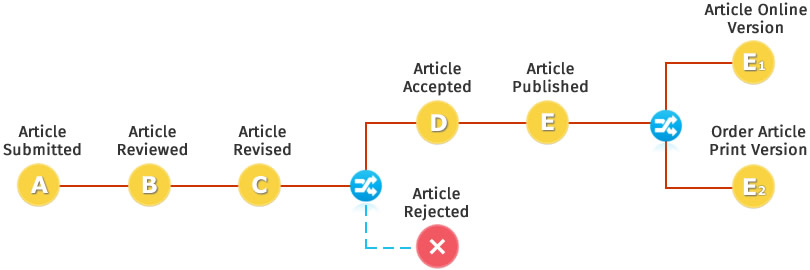
Journal Article Workflow

Frontier Management Science (FMS) follows a structured journal article workflow to ensure that every manuscript is handled professionally, transparently, and ethically from submission to publication. The workflow is designed to maintain academic quality, editorial integrity, and timely publication.
1. Manuscript Submission
Authors submit their manuscripts through the official Frontier Management Science (FMS) online submission system. During submission, authors must provide complete metadata, including title, abstract, keywords, author names, affiliations, email addresses, ORCID IDs if available, references, and supporting documents when required.
Authors must ensure that the submitted manuscript follows the journal template, author guidelines, citation style, and ethical requirements.
2. Administrative Check
After submission, the editorial office conducts an administrative check to ensure that the manuscript is complete and properly prepared.
This stage includes checking:
- Manuscript file completeness
- Title, abstract, and keywords
- Author information and affiliations
- Corresponding author details
- Reference format
- Tables and figures
- Required statements, including conflict of interest, funding, author contributions, and data availability
- Compliance with the journal template and author guidelines
Manuscripts that are incomplete or do not follow the basic requirements may be returned to the author for correction before editorial screening.
3. Initial Editorial Screening
The Editor-in-Chief or assigned editor reviews the manuscript to determine whether it is suitable for further processing.
The screening considers:
- Relevance to the journal’s aims and scope
- Originality and novelty
- Clarity of research problem
- Academic contribution
- Quality of writing
- Methodological appropriateness
- Ethical compliance
Manuscripts that are outside the journal scope, lack academic contribution, contain serious methodological weaknesses, or fail to meet ethical standards may be rejected at this stage without external peer review.
4. Similarity and Plagiarism Check
Manuscripts that pass the initial screening are checked using plagiarism or similarity detection tools.
The journal may reject or return a manuscript for revision if it contains:
- High similarity index
- Plagiarism
- Duplicate publication
- Improper citation
- Text recycling without proper acknowledgment
- Suspected data fabrication or falsification
The recommended similarity level is generally below 20%, excluding references, direct quotations, and common methodological terms.
5. Reviewer Assignment
Manuscripts that pass the editorial screening and similarity check are assigned to at least two independent reviewers with relevant expertise.
Reviewers are selected based on their:
- Academic expertise
- Research background
- Methodological competence
- Publication record
- Availability
- Absence of conflict of interest
FMS applies a double-blind peer review process, meaning that the identities of authors and reviewers are kept confidential.
6. Peer Review Process
Reviewers evaluate the manuscript based on academic merit, originality, methodological rigor, relevance, clarity, and contribution to the field.
Reviewers are asked to assess:
- Originality and novelty
- Relevance to FMS scope
- Strength of theoretical foundation
- Appropriateness of methodology
- Quality of data analysis
- Validity of findings
- Discussion and interpretation
- Contribution to theory, practice, or policy
- Quality of references
- Ethical compliance
- Clarity of writing and structure
7. Reviewer Recommendations
After completing the review, reviewers provide comments and recommendations to the editor.
Possible recommendations include:
- Accept Submission
- Revisions Required
- Resubmit for Review
- Resubmit Elsewhere
- Decline Submission
- See Comments
Reviewer comments are used to support editorial decision-making and to help authors improve their manuscripts.
8. Editorial Decision
The Editor-in-Chief or assigned editor makes the editorial decision based on reviewer recommendations, manuscript quality, ethical compliance, and relevance to the journal’s scope.
Possible decisions include:
- Accepted
- Accepted with minor revisions
- Major revisions required
- Resubmit for review
- Rejected
The decision is communicated to the corresponding author through the online journal system.
9. Author Revision
If revision is required, authors must revise the manuscript according to reviewer and editor comments.
Authors should submit:
- Revised manuscript
- Response to reviewers
- Explanation of changes made
- Highlighted or tracked-changes version, if requested
Authors should respond to each reviewer comment clearly and respectfully. If authors disagree with a suggestion, they should provide a clear academic justification.
10. Re-Evaluation
Revised manuscripts are evaluated by the editor. Manuscripts with major revisions may be sent back to the original reviewers or new reviewers for further assessment.
The re-evaluation process checks whether:
- Reviewer comments have been addressed
- The manuscript has been improved
- The method, analysis, and discussion are strengthened
- Ethical and formatting requirements are fulfilled
Minor revisions may be evaluated directly by the editor without another external review.
11. Final Acceptance
A manuscript is accepted only after it meets the journal’s standards for academic quality, originality, methodological rigor, ethical compliance, and contribution to the field.
The acceptance decision is issued by the Editor-in-Chief or assigned editor. Authors will receive an official acceptance notification through the online journal system or editorial communication.
12. Article Processing Charge
After acceptance, authors are required to complete the Article Processing Charge, if applicable.
For FMS:
| Type of Charge | Amount |
|---|---|
| Submission Fee | USD 0 |
| Review Fee | USD 0 |
| Article Processing Charge | USD 100 |
Payment of the APC does not influence editorial decisions and does not guarantee acceptance. APC payment is requested only after the manuscript has been accepted for publication.
13. Copyediting
Accepted manuscripts proceed to the copyediting stage. The copyediting process improves clarity, grammar, consistency, formatting, references, and journal style while preserving the author’s original meaning.
Authors may be contacted during this stage if clarification is required.
14. Layout Editing
After copyediting, the manuscript is prepared in the journal’s publication format. This stage includes formatting the article layout, tables, figures, headings, references, article metadata, DOI information, and publication details.
The layout version is prepared for online publication.
15. Author Proofreading
The final proof is sent to the corresponding author for proofreading. Authors are responsible for checking:
- Author names and affiliations
- Title and abstract
- Tables and figures
- References
- DOI and metadata
- Typographical errors
- Final article content
Only minor corrections are allowed at this stage. Major content changes are not normally permitted after acceptance.
16. DOI Registration and Metadata Preparation
Before publication, the journal prepares article metadata and registers the article DOI through Crossref or another DOI registration agency used by the journal.
Metadata may include:
- Article title
- Author names
- Affiliations
- Abstract
- Keywords
- References
- DOI
- Volume, issue, and publication date
- License information
17. Online Publication
After final proofreading and DOI registration, the article is published online on the official Frontier Management Science (FMS) website.
Published articles are made freely available under the journal’s open-access policy and Creative Commons license.
18. Indexing and Archiving
After publication, article metadata may be distributed to indexing, abstracting, discovery, and archiving services.
This may include:
- Crossref
- Google Scholar
- Dimensions
- OpenAlex
- Garuda
- Indonesia OneSearch
- BASE
- ROAD
- WorldCat
- Semantic Scholar
- Other relevant databases and repositories
Indexing availability depends on each database’s selection policy and technical harvesting process.
19. Post-Publication Updates
After publication, authors and readers may contact the editorial office if corrections are needed. FMS may issue corrections, retractions, expressions of concern, or updates when necessary, following ethical publishing standards.
Post-publication actions may include:
- Correction
- Erratum
- Retraction
- Withdrawal
- Expression of concern
20. Workflow Summary
| Stage | Responsible Party | Output |
|---|---|---|
| Manuscript submission | Author | Submitted manuscript |
| Administrative check | Editorial office | Complete or returned submission |
| Editorial screening | Editor | Desk review decision |
| Similarity check | Editorial office | Similarity report |
| Reviewer assignment | Editor | Review invitation |
| Peer review | Reviewers | Review reports |
| Editorial decision | Editor | Decision letter |
| Revision | Author | Revised manuscript |
| Re-evaluation | Editor / reviewers | Revision assessment |
| Final acceptance | Editor-in-Chief / editor | Acceptance letter |
| APC processing | Author / editorial office | Payment confirmation |
| Copyediting | Editorial team | Edited manuscript |
| Layout editing | Production team | Article proof |
| Proofreading | Author | Approved final proof |
| DOI registration | Editorial office | DOI and metadata |
| Online publication | Journal | Published article |
| Indexing and archiving | Journal / databases | Discoverable article |
| Post-publication update | Editorial office | Correction or update, if needed |
21. Estimated Timeline
| Workflow Stage | Estimated Time |
|---|---|
| Administrative check | 3–7 days |
| Editorial screening | 1–2 weeks |
| Similarity check | 3–7 days |
| Peer review | 3–6 weeks |
| Author revision | 1–4 weeks |
| Re-evaluation | 1–3 weeks |
| Copyediting and layout editing | 1–3 weeks |
| Proofreading | 3–7 days |
| Online publication | 1–2 weeks after final proof approval |
The actual timeline may vary depending on manuscript quality, reviewer availability, revision complexity, author response time, and editorial workload.